

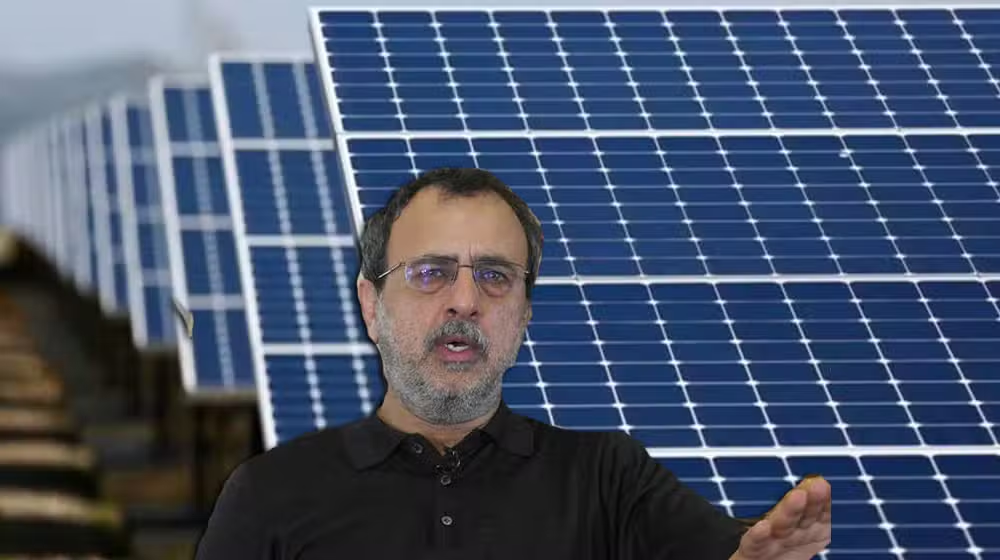
Federal Minister for Energy Awais Leghari has issued a firm defense of the government’s current energy roadmap, rejecting widespread claims that his ministry is actively discouraging the adoption of solar power. In a detailed policy statement, the Minister clarified that while the government fully supports the transition to renewable energy, it must manage the expansion of rooftop solar to prevent “unfair” cost-shifting onto non-solar consumers and to maintain grid stability during peak evening hours when solar generation naturally drops.
The Minister’s remarks come at a time of significant regional volatility. Leghari revealed that LNG imports to Pakistan have been severely disrupted following a force majeure declaration by QatarEnergy, a direct consequence of the escalating US-Israel conflict with Iran. This supply shock has forced authorities to implement targeted demand management measures. However, the Minister offered assurances that critical sectors—most notably the fertilizer industry—will be shielded from these curbs to ensure national food security. He further dismissed proposals to entirely phase out gas-fired power plants in favor of coal, explaining that gas remains an essential tool for managing rapid fluctuations in electricity usage.
On the industrial front, Leghari challenged the narrative that high tariffs are driving businesses off the national grid. He highlighted that electricity demand actually saw robust growth in early 2026, recording a 12.1% year-on-year increase in January and nearly 11% in February. This surge in demand has been attributed to the government’s surplus electricity package, which offers power at a discounted rate of approximately Rs. 23 per unit. According to the Ministry, industrial consumers have collectively saved roughly Rs. 12 billion through this incentive program during the first two months of the year.
Concluding his statement, Leghari emphasized that Pakistan’s diversified power generation mix has acted as a crucial buffer against global energy shocks. He noted that the government is moving forward with structural reforms, including privatization and market liberalization through third-party grid access, to create a more competitive and resilient energy sector. Despite the challenges posed by international supply chains, the Minister maintained that the current policy framework is designed to balance affordability with the long-term technical requirements of the national grid.