

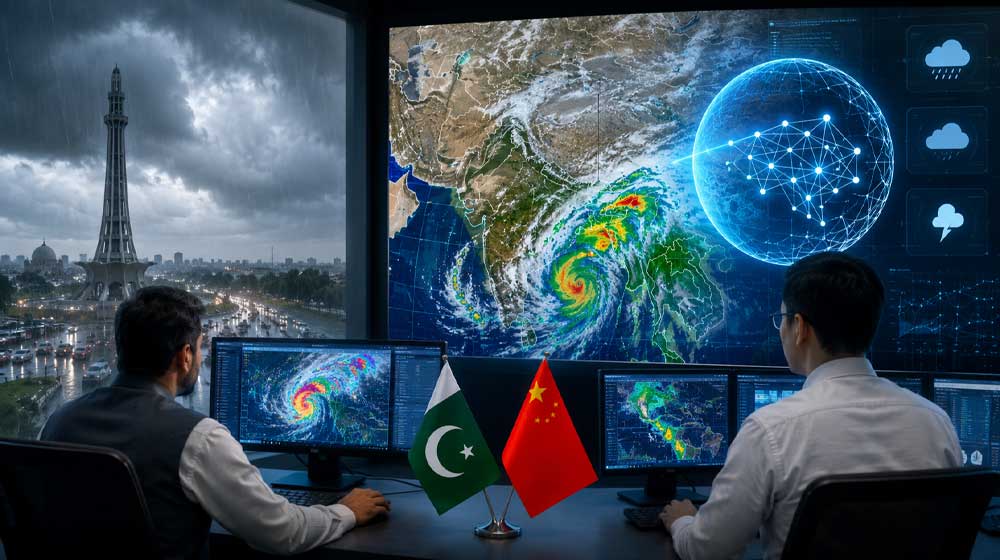
Pakistan is deploying an unconventional tool to fight the monsoon threat. The country has begun using China’s MAZU-Urban system, an AI-powered early warning platform designed specifically for developing nations. Therefore, Pakistan weather monitoring AI capabilities are about to receive a significant upgrade as the monsoon season intensifies.
The MAZU-Urban system emerged from the China Meteorological Administration. It represents Beijing’s effort to help developing countries reduce climate-related disaster impacts. Moreover, the platform combines real-time monitoring with artificial intelligence to predict and prepare for multiple hazard types simultaneously.
AI System for Multiple Weather Risks
The system delivers real-time monitoring and AI-generated emergency plans for different disaster scenarios. Floods, typhoons, and agricultural risks all fall within its monitoring scope. Additionally, the platform operates as an open-source AI model developed in China. Consequently, local users can adjust the system according to their specific needs and conditions.
This flexibility matters enormously for Pakistan’s unique geography and weather patterns. The monsoon system that pounds South Asia differs significantly from typhoons affecting East Asia. Therefore, Pakistan weather monitoring AI users can customize MAZU-Urban for regional meteorological realities.
Room for Better Forecasts
Frukh Bashir, head of research and development at the Pakistan Meteorological Department, sees real potential. He says the system could help Pakistan develop more comprehensive forecasting products. Furthermore, such tools could make weather forecasting significantly more effective nationwide.
Bashir emphasized that better predictions could help authorities anticipate extreme events before they strike. Floods, droughts, and other disasters create cascading problems for the public. However, advanced warning systems reduce casualties and allow preparation time. Therefore, investing in Pakistan weather monitoring AI represents a smart allocation of resources.
China Supports AI Access for Developing Countries
Chinese officials framed MAZU-Urban as part of a broader artificial intelligence cooperation strategy. Zhang Kailin, deputy director of the Department of Innovation and High-Tech Development at the National Development and Reform Commission, explained the rationale. He said China supports people-centered AI approaches that promote open-source access and safety controls.
Kailin emphasized that China aims to strengthen AI capacity in the Global South. The goal involves balancing technological progress with security governance. Additionally, it means helping AI serve society more effectively across developing regions.
Chinese AI Models See Global Use
China claims its open-source AI models have been downloaded more than 10 billion times globally. That figure reportedly exceeds downloads of AI models from any other country. Meanwhile, entrepreneurs and research teams worldwide continue adapting Chinese large language models.
According to Chinese statistics, more than 200 derivative models emerge daily from existing Chinese AI frameworks. This level of adoption suggests real utility beyond political messaging. Gan Xiaobin, deputy director of the Science and Technology Department at the Ministry of Industry and Information Technology, detailed China’s contributions.
He said China has provided affordable open-source AI models, intelligent products, and equipment to global users. Furthermore, he called this approach part of global AI governance. China positions itself as supporting openness and cooperation in building a diverse AI innovation ecosystem.
Zimbabwe Also Using Chinese AI Support
Pakistan is not alone in adopting Chinese technology solutions. Zimbabwe represents another example of Chinese technology support reaching developing countries. A supercomputing center built with Chinese government aid has become foundational for Zimbabwe’s artificial intelligence development.
Chinese officials describe this support as part of their effort to narrow the global intelligence gap. The implication is clear—developing nations need access to advanced technology to compete globally. Therefore, providing affordable AI tools serves both humanitarian and strategic interests.
Finally, Pakistan weather monitoring AI adoption signals a pragmatic approach to climate preparedness regardless of geopolitical considerations.