Pakistan Economic Survey 2026 shows GDP growth, fiscal improvement, and digital gains alongside rising poverty, unemployment, and climate damage
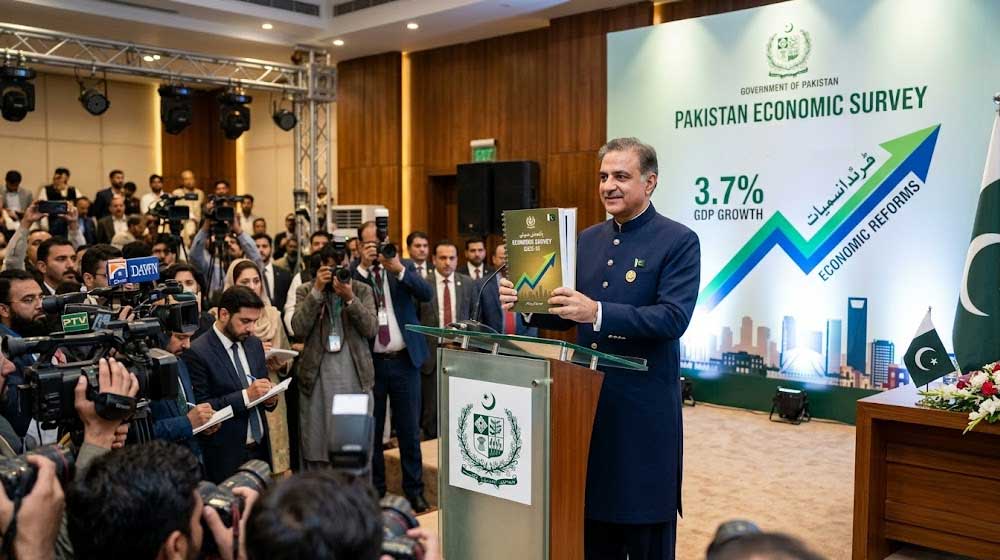
Pakistan’s Finance Minister Muhammad Aurangzeb launched the Pakistan Economic Survey 2025-26 on Thursday, presenting a picture of recovery alongside persistent challenges. The Pakistan Economic Survey 2026 shows the economy grew 3.7 percent in FY2025-26, up from 3.18 percent the previous year. Moreover, per capita income climbed to $1,901 from $1,751, and GDP at current market prices reached Rs. 126.9 trillion. The survey credits effective macroeconomic management, IMF programme reforms, and exchange rate stability for the improvement.
GDP and Income Rise
The services sector led growth, contributing 58.4 percent of GDP and expanding 4.09 percent. Agriculture grew 2.89 percent while industry expanded 3.51 percent. Furthermore, Large-Scale Manufacturing recorded strong growth of 6.11 percent. Therefore, all three major sectors contributed positively to the overall GDP figure.
Fiscal Position Improves Sharply
Public finances improved significantly. The fiscal deficit narrowed to 0.7 percent of GDP during July-March FY2026, down from 2.6 percent in the same period last year. Furthermore, total revenue increased 10.7 percent to Rs. 14.8 trillion. Total expenditure declined 4.2 percent, largely driven by a 23.2 percent reduction in debt servicing costs. The primary surplus reached 3.2 percent of GDP.
Inflation Remains Manageable Despite Oil Shock
Inflation averaged 6.2 percent during July-April FY2026. However, it accelerated from 7.3 percent in March to 10.9 percent in April following rising global oil prices and Middle East supply disruptions. Furthermore, the government noted inflation stayed largely stable through the first three quarters before external shocks hit.
Agriculture Recovers After Floods
Agriculture rebounded strongly after the devastating 2025 floods, growing 2.89 percent against 1.53 percent the previous year. Wheat output reached 29.61 million tonnes, up 4.3 percent. Sugarcane hit 89.45 million tonnes, up 6.2 percent. Furthermore, livestock expanded 3.75 percent and fertilizer offtake rose 11.4 percent during July-March FY2026.
Manufacturing Shows Strong Revival
Manufacturing expanded 6.6 percent. Sixteen of 22 major manufacturing sectors recorded growth, including food, textiles, automobiles, petroleum products, and electrical equipment. Furthermore, mining and quarrying returned to positive territory after four consecutive years of contraction.
Investment and Savings Strengthen
Private investment increased 12.8 percent, signalling improving business confidence. Gross Fixed Capital Formation rose 10.9 percent to Rs. 16.07 trillion. Furthermore, national savings stood at 14.13 percent of GDP, reducing reliance on foreign financing.
External Sector Remains Stable
Pakistan recorded a current account surplus of $72 million during July-March FY2026. Workers’ remittances grew 8.2 percent to $30.3 billion. Furthermore, IT exports increased 19.8 percent and foreign exchange reserves reached $21.8 billion by end-March 2026. The exchange rate held stable around Rs. 281 per dollar.
Digital Economy Records Rapid Growth
ICT exports rose 19.7 percent to $3.38 billion. Freelancer exports surged 51 percent to $856 million. Furthermore, broadband subscribers reached 161 million and Pakistan conducted its first major 5G spectrum auction, generating $509.6 million. The government also approved Pakistan’s Artificial Intelligence Policy 2025.
Stock Market Outperforms
The KSE-100 gained 18.4 percent during July-March FY2026 as lower inflation, monetary easing, and IMF progress drove investor confidence. Furthermore, market capitalisation rose from Rs. 15.2 trillion to Rs. 16.5 trillion.
Poverty and Employment Challenges Persist
Despite the positive headline numbers, challenges remain serious. The national poverty rate increased to 28.9 percent in 2024-25 due to inflation, climate shocks, and economic adjustments. Furthermore, unemployment rose to 7.1 percent from 6.3 percent, even as total employment reached 77.2 million people.
Energy Transition Accelerates
Installed electricity generation capacity reached 49,651 MW. Hydel, nuclear, and renewable sources now account for 50.8 percent of installed capacity, surpassing thermal power’s share for the first time. Furthermore, petroleum imports rose 10.5 percent amid higher economic activity.
Climate Change Remains Major Risk
The 2025 floods caused Rs. 822 billion in damages, killed more than 1,039 people, and displaced over 4 million. Furthermore, Pakistan recorded its second warmest year in 65 years during 2025. Finally, the survey identifies climate change as one of the country’s most serious long-term economic threats — and the numbers from 2025 make that case impossible to ignore.