
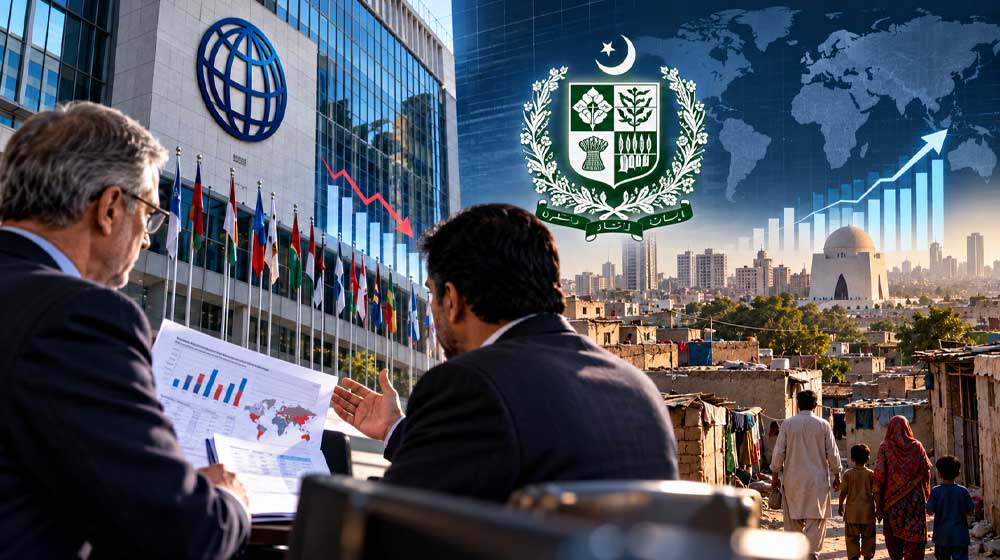
The federal government has challenged the World Bank’s new poverty figures, saying Pakistan’s inclusion in the Middle East, North Africa, Afghanistan and Pakistan (MENAAP) region has distorted regional comparisons. Officials say the reclassification made the country’s share of regional poverty look larger. Finance minister’s adviser Khurram Schehzad said the World Bank moved Pakistan from South Asia to MENAAP.
However, he described the move as an administrative and statistical reclassification. It changed the composition of regional figures, he said, not Pakistan’s geographical identity or income classification.
Moreover, Schehzad argued that regional poverty rates can change when countries join or leave a statistical group. Rates can shift even when poverty within individual countries remains the same. Pakistan’s large population would significantly affect MENAAP’s totals.
Meanwhile, its removal would also change South Asia’s aggregate numbers. Schehzad offered a hypothetical example. Adding a country with a higher poverty rate would raise a region’s overall rate, even if conditions in both countries stay the same. Therefore, he said poverty figures should be compared using country-level data with the same threshold and reference year.
The comments followed the World Bank’s October 2026 economic update. It said Pakistan accounts for nearly half of the people living in extreme poverty across MENAAP. However, the report does not blame Pakistan’s rising poverty rate on the new classification.
Pakistan’s poverty rate rose by 6.4 percentage points at the $3-a-day line between fiscal years 2018-19 and 2024-25. Furthermore, the rate rose 3.2 percentage points at the $4.20-a-day line over the same period. The bank links the increase to the COVID-19 pandemic, the 2022 floods, high inflation, currency depreciation and prolonged economic adjustment. These shocks weakened household incomes and employment opportunities.
Still, the report says Pakistan accounts for about 48 percent of people below the $3-a-day line across MENAAP. The inclusion of Pakistan affects the region’s aggregate numbers. Instead, the lender’s country-level figures compare poverty within Pakistan over time. Finally, the dispute shows how regional groupings can shape poverty reporting.