
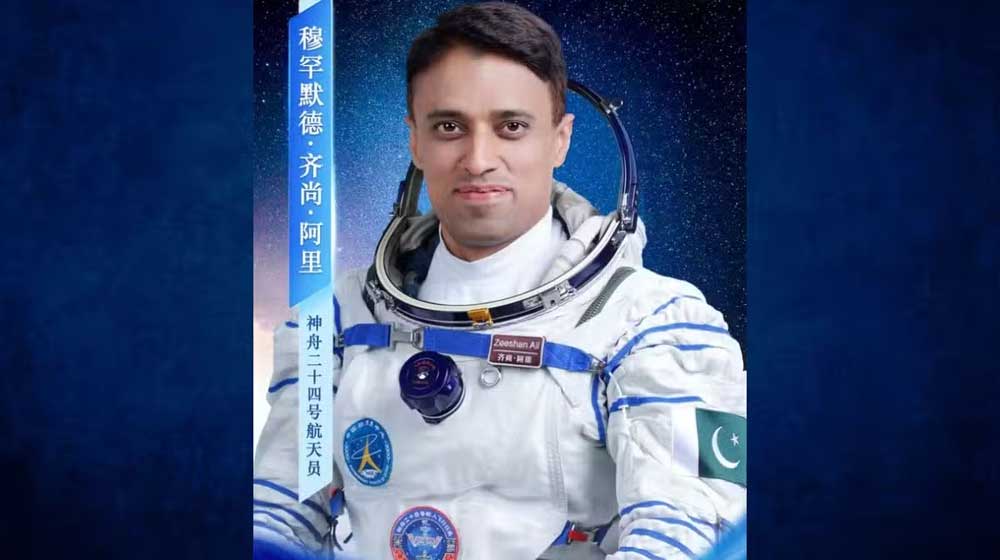
Muhammad Zeeshan Ali, 40, has been named to the crew of China’s Shenzhou-24 mission. He is a former pilot in Pakistan’s armed forces and will become the first Pakistani to go to space. He will also be the first foreign astronaut to board China’s space station.
China Manned Space Agency announced the crew on Tuesday, November 24, 2026. It will be the first flight in China’s crewed space programme that carries both Chinese and foreign astronauts. abcnews
Launch at 5:18 am Pakistan time
Shenzhou-24 is set to lift off from the Jiuquan Satellite Launch Center in northwest China on Wednesday, November 25. The launch time is 8:18 am Beijing time, which is 5:18 am in Pakistan.
Muhammad Zeeshan Ali will fly with two Chinese astronauts, Tang Hongbo, 51, and Wu Yi, 39. Tang Hongbo has flown twice before. He will become the first astronaut to board the Tiangong station three times. Wu Yi is on his first flight.
What he will do in orbit
Muhammad Zeeshan Ali will work as a payload specialist, which means he looks after science experiments. He is expected to spend around a week on the station. His own work covers four science projects in biotechnology and materials. One tests how tiny living things that make food from sunlight, like plants do, behave in space. dawn
The full crew will carry out around 90 experiments during the mission. When his stay ends, Muhammad Zeeshan Ali will come home on the Shenzhou-23 spacecraft with the crew members finishing their six-month stay on the station. dawnscmp
How Pakistan got this seat
In February 2025, Pakistan’s space agency Suparco signed an agreement with China Manned Space Agency. Two Pakistanis would train in China, and one would fly to Tiangong. Muhammad Zeeshan Ali and Khurram Daud were chosen in April 2026 to begin that training.
At a press briefing, Muhammad Zeeshan Ali said he had learned Chinese and could now talk with his crewmates in the language. He said: “Now, this dream belongs to me and also belongs to Pakistan.”
Planning Minister Ahsan Iqbal congratulated him and called the mission a sign of trust between Pakistan and China.
China has built its own station because it has been barred from the International Space Station since 2011, when the United States stopped NASA from working with Chinese space agencies. Since then, Beijing has looked for partners of its own, and it hopes to land astronauts on the Moon by 2030.