
Pakistan is facing one of its toughest energy crises in years. Middle East tensions — including Iran’s blockade of the Strait of Hormuz after US and Israeli strikes — have disrupted global oil supplies, sent crude prices soaring to $115 per barrel, and forced a 20% hike in local petrol and diesel prices. Reserves are critically low: crude oil for just 11 days, diesel for 21 days, and petrol for 27 days.
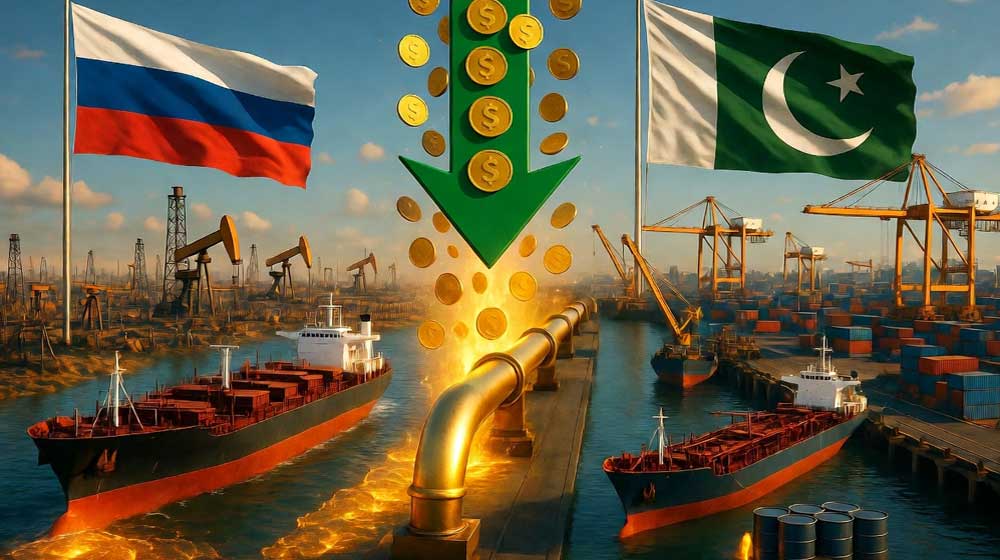
In this dire situation, today’s headline from Geo.tv hits like fresh hope: Russia’s Ambassador to Pakistan, Albert Khorev, has openly declared that Moscow is ready to supply discounted oil to Pakistan — if Islamabad makes a formal request. Speaking at a press conference in Islamabad, the envoy stressed that energy cooperation is the “most important pillar” of bilateral ties and urged Pakistan to seize the opportunity.
This isn’t the first time Russia has extended such an olive branch. Pakistan imported its first discounted Russian crude in 2023 and explored deeper deals as recently as December 2025. But today’s statement comes at the perfect storm. Here’s a complete breakdown of why Russia’s discounted oil will massively benefit Pakistan — economically, strategically, and for everyday citizens.
1. Massive Savings on the Import Bill — Relief for a Cash-Strapped Economy
Pakistan spends roughly $18 billion annually on energy imports — one of the biggest drains on foreign reserves. Every dollar saved on oil directly strengthens the rupee and reduces the current account deficit.
Russian Urals crude has historically traded at steep discounts compared to Saudi or Gulf benchmarks. In past deals, Pakistan secured oil well below the $60–80 international range (sometimes $16–18 cheaper per barrel). In today’s $115-per-barrel market, even a modest 15–20% discount could save hundreds of millions of dollars per shipment.
These savings mean:
- Less pressure on the State Bank’s dwindling reserves
- Reduced need for emergency IMF bailouts
- More fiscal space for development spending instead of fuel subsidies
Finance Minister Muhammad Aurangzeb’s recent remarks (December 2025) about ongoing energy-ministry talks with Russia show Islamabad already understands this math. A new formal deal could lock in long-term discounted supplies exactly when Pakistan needs them most.
2. Lower Petrol, Diesel & Power Prices — Direct Relief for Citizens & Inflation
Fuel prices affect everything: transport fares, food costs, electricity bills, and factory production.
When Pakistan refined its first Russian cargo in 2023, ministers promised pump prices would fall. Even without an “exclusive” discount (as Russia clarified at the time), the overall cost advantage still delivered savings. In the current crisis, with local prices already up 20%, discounted Russian oil could quickly reverse that hike.
Lower diesel prices = cheaper trucking and agriculture (tractors, tube-wells). Lower furnace oil costs = cheaper electricity generation (Pakistan still relies on thermal power). Result? Reduced inflation, especially food inflation, which hits poor families hardest.
Analysts from past deals estimated that importing even one-third of crude needs from Russia could create a “big difference in prices” felt directly in people’s pockets.
3. Energy Security & Diversification — Breaking Dependence on Volatile Middle East
Pakistan’s traditional suppliers (Saudi Arabia, UAE, Qatar) are reliable — until they aren’t. The current Hormuz blockade and regional conflict prove how fragile that dependence is. LNG supplies are already running out after April 14.
Russia offers a stable alternative:
- Vast reserves unaffected by Gulf politics
- Willingness to accept payment in friendly currencies (Pakistan paid the 2023 shipment in Chinese yuan)
- Potential for long-term government-to-government contracts
Diversifying sources reduces geopolitical risk and gives Pakistan bargaining power with traditional suppliers. Russia also gains a new Asian market amid Western sanctions — a win-win strategic partnership.
4. Boost to Industries, Transport, Agriculture & Overall GDP Growth
Cheaper energy is rocket fuel for the economy:
- Transport & logistics — lower costs for trucks, CNG, and railways
- Agriculture — cheaper diesel for machinery and irrigation
- Manufacturing — reduced power tariffs help textiles, cement, and steel (key export sectors)
- Refineries — steady crude supply keeps local refineries running at full capacity
Past Russian imports already helped Pakistan avoid worse shortages in 2023. Scaling that up in 2026 could add meaningful GDP growth points and create jobs in refining, logistics, and downstream industries.
5. Strategic & Diplomatic Gains — Strengthening Russia-Pakistan Ties
Energy cooperation is the gateway to broader partnership. Russia has strengths in exploration, production, refining, and even steel plants (as Finance Minister Aurangzeb noted). A successful oil deal could open doors to:
- Joint ventures in minerals and upstream oil/gas
- Technology transfers for refinery upgrades
- Stronger diplomatic backing on issues like Kashmir or regional stability
The envoy’s emphasis on energy as the “most important pillar” signals Moscow’s serious intent. For Pakistan, this diversifies alliances beyond traditional Western and Gulf partners — smart hedging in a multipolar world.
Addressing the Realities: Challenges Exist, But Are Manageable
No deal is perfect. Russian Urals crude is heavier than Arabian Light, producing more furnace oil (which Pakistan needs less of) and requiring some refinery adjustments. Transportation and insurance costs can be higher. Past deals faced teething issues on volume and quality.
However, Pakistan’s refineries successfully processed earlier shipments. The current crisis — with prices at $115 and reserves for mere days — makes the net benefit overwhelmingly positive. Temporary Euro-5 quality waivers already granted show the government is ready to adapt quickly.
Conclusion: Pakistan Must Act Fast — This Is a Once-in-a-Crisis Opportunity
Ambassador Khorev’s message is crystal clear: “Moscow would sell discounted oil if Islamabad formally approaches.” With the Middle East on fire, reserves running out, and prices at record highs, delaying this formal request would be a missed golden chance.
A discounted Russian oil deal would:
- Cut the import bill
- Tame inflation
- Secure energy supply
- Boost growth
- Strengthen strategic ties
All while delivering immediate relief to 240 million Pakistanis struggling with high fuel and electricity costs.
The ball is now in Islamabad’s court. Given today’s press conference and the urgency of the crisis, expect swift diplomatic movement. If executed well, this could be remembered as the moment Pakistan turned an energy nightmare into an economic lifeline.