
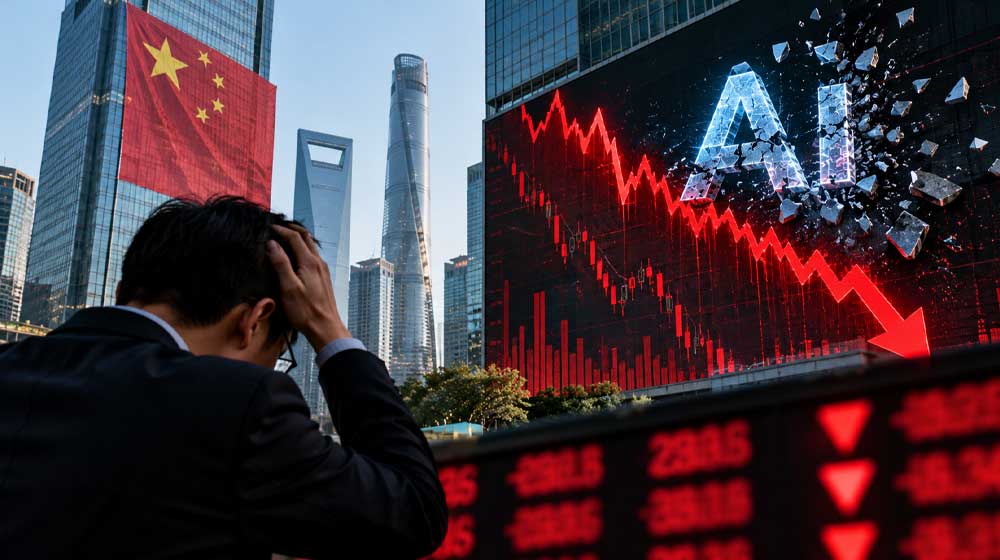
The China AI bubble has burst. Shares of China’s top AI and chip companies have crashed 40% in less than four months, wiping out about $480 billion in value, according to a Reuters analysis published on October 26, 2026.
The fall is measured by the STAR50, a group of 50 leading tech companies on the Shanghai stock market. A “bubble” is when share prices climb far above what companies are really worth, often because people buy in a rush, not because profits justify it.
Beijing-based fund manager Dong Baozhen told Reuters the market had turned into a wild, speculative rally. “And now we see the bubble bursting,” Dong Baozhen said.
Bigger than Pakistan’s economy
The size of the loss is hard to picture. At the rupee’s closing rate of Rs. 276.80 per dollar on October 27, $480 billion is about Rs. 133 trillion.
That is more than everything Pakistan produces in a whole year. Pakistan’s economy reached a record $452.1 billion in 2025-26, according to the Economic Survey. The Pakistan Bureau of Statistics later revised that figure to $450.4 billion. In under four months, Chinese investors lost about 7% more than that on AI shares alone.
Hot stocks cut in half
Many of China’s best-known AI names have been hit hard. Shares in robot maker Unitree have halved since they began trading in August. When Unitree first sold shares, ordinary buyers asked for 8,000 times more than were on offer.
Chipmakers MetaX and Moore Threads, which jumped 700% and 400% on their first trading days last year, have also halved since July. Optical parts makers Zhongji Innolight and Eoptolink are down about 60% from their summer highs, partly because the US is moving to ban them from supplying American data centres.
Small investors are feeling the pain most. According to Goldman Sachs, AI shares make up 42% of the value of China’s stock market and 57% of all trading. Chen Wensheng, a small business owner from Hainan, told Reuters he bought in because he believed the government backed companies like Unitree. He and his friends are now sitting on losses.
No single trigger
Reuters found no one clear reason for the selling. Traders blamed sky-high prices, tax bills and the risk that the US or other countries could ban Chinese equipment in data centres.
The crash goes beyond AI. China’s main index of big companies has fallen about 20% from its June high. In the US, the damage is much smaller so far. US AI stocks have pulled the Nasdaq down only about 6% from its record high three weeks ago.
The crash is also a setback for Beijing. China has been trying to get its people to move savings into the stock market to fund the AI boom, and to build a slow, steady rise instead of booms and crashes.
Still expensive after the fall
Some experts warn that prices are still high. Even after the crash, STAR50 shares trade at about 100 times their past year’s profits, down from almost 250. The Nasdaq 100 trades at about 30 times. In simple words, buyers are paying about Rs. 100 for every Rs. 1 these Chinese companies earned in a year.
Hong Hao, chief investment officer at Lotus Asset Management in Hong Kong, said the crash will stop many companies that were planning to list on the stock market. Wang Zhuo of Shanghai Zhuozhu Investment Management said chipmakers and AI suppliers will end up in a price war like other Chinese manufacturers, adding that every bubble bursts in the end.
Not everyone is gloomy. Goldman Sachs still lists Innolight and chipmaker CXMT among dozens of Chinese AI stocks it recommends, and BNP Paribas strategist William Bratton has said careful buyers may find chances in the market. China’s market regulator did not reply to Reuters’ questions.