

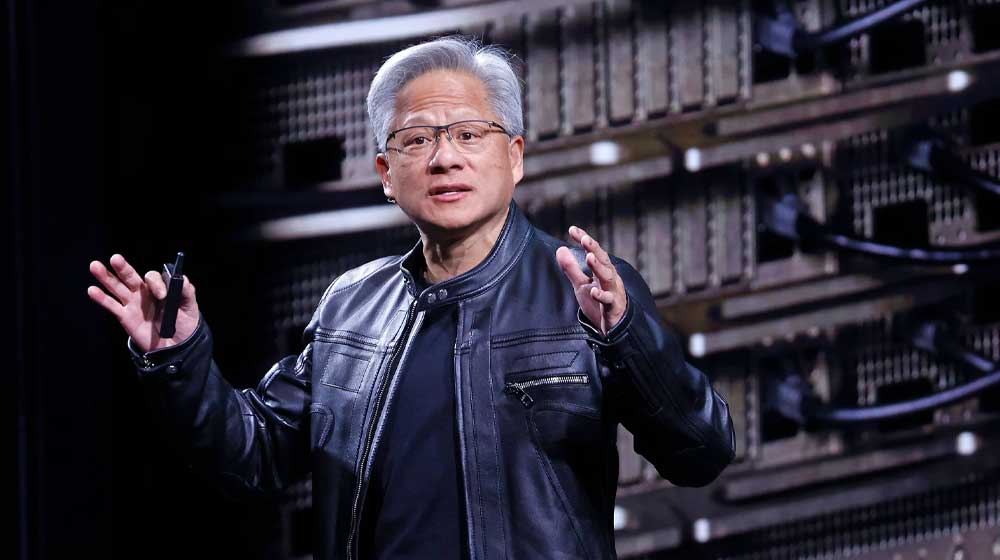
The definition of Artificial General Intelligence (AGI) is shifting from a philosophical “holy grail” to a practical business benchmark. In a recent discussion on the Lex Fridman Podcast, Nvidia CEO Jensen Huang boldly claimed that AGI is already here, provided we use a specific, functional definition: the ability of an AI to build and run a billion-dollar company.
The “Functional AGI” Threshold
Huang’s perspective is rooted in economic utility rather than human-like consciousness. He pointed to open-source platforms like OpenClaw—which allows users to run autonomous AI agents locally—as evidence that AI can now create high-value digital services. According to Huang, it is entirely possible for an AI agent to build a web app that briefly captures the attention of billions of users, generating massive short-term value.
However, Huang added a critical caveat: temporary success does not equal “forever.” He compared these AI-driven ventures to the dot-com boom, where companies achieved explosive growth only to fade away. While AI can manage tasks and even create billion-dollar “flashes in the pan,” Huang remains skeptical that autonomous agents could replicate the deep organizational strategy and long-term innovation required to build a company as complex as Nvidia.
The Industry Divide: Two Years or Ten?
While Huang sees AGI as a present-day reality in a limited sense, other industry titans offer vastly different timelines based on their own requirements for “true” intelligence:
- Elon Musk (xAI): Maintaining one of the most aggressive timelines, Musk has suggested AGI could emerge as early as this year or by 2027, driven by massive scaling of hardware like the “Colossus” supercomputer.
- Demis Hassabis (Google DeepMind): Takes a more cautious scientific approach, estimating that AGI is still five to eight years away. He argues that current models still lack “continual learning” and the ability to perform complex, long-term planning without human intervention.
- Sam Altman (OpenAI): Has previously hinted that AGI might “whoosh” by without a single, clear “Eureka” moment, as AI gradually integrates into every facet of human productivity.
The Human-Machine Ecosystem
The lines between these competing visions are blurring. Peter Steinberger, the creator of OpenClaw, recently joined OpenAI, while Nvidia has launched its own version of the platform, NemoClaw. This cross-pollination suggests that the race for AGI is no longer just about building a “brain” in a lab, but about creating an ecosystem where autonomous agents can perform meaningful, high-stakes work in the real world.
Ultimately, whether AGI is a “now” or a “later” depends on the yardstick. If the goal is economic output and task execution, we may have already crossed the finish line. If the goal is a machine that reasons, learns, and persists like a human, the journey is only beginning.