

The International Monetary Fund has reached a staff-level agreement with Pakistan on the fourth review of its Extended Fund Facility (EFF) and the third review of its Resilience and Sustainability Facility (RSF). This IMF agreement could release about $1.2 billion once the Executive Board approves it.
Roughly $1.0 billion would come under the EFF, and about $210 million under the RSF. Moreover, total disbursements under the two arrangements would reach about $5.7 billion. An IMF team led by Iva Petrova held talks in Karachi and Islamabad from September 23 to October 7, 2026. The talks also covered the 2026 Article IV consultation.
Economy Holds Up Despite Shocks
Petrova said the EFF helped authorities navigate the impact of the Middle East conflict and preserve macroeconomic stability. Real GDP growth reached an estimated 3.6 percent in fiscal 2026. Growth had reached 4 percent in the first three quarters. However, higher energy prices and supply disruptions later slowed momentum.
Inflation eased to about 10.3 percent in September after peaking in May. Meanwhile, the current account stayed broadly balanced in FY26 thanks to strong remittances. Gross reserves also rose to about $21.5 billion by the end of September. Still, the Fund cautioned that geopolitical tensions, volatile energy prices and tighter global financial conditions keep risks high.
Policy Priorities
The IMF urged Islamabad to keep to the FY27 budget, which targets an underlying primary surplus of 2.0 percent of GDP. Furthermore, it called for revenue reforms such as risk-based audits, digital invoicing and third-party data. It also urged a medium-term tax strategy to make the system fairer, simpler and more growth friendly.
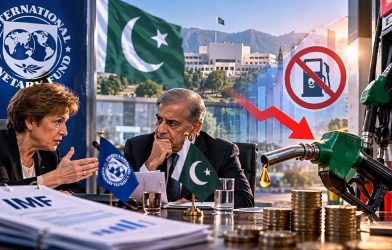
Health and education spending rose from 2.2 percent of GDP in FY24 to 2.5 percent in FY26. Additionally, the government has committed to raising it to 2.8 percent in FY27. The Fund also urged a prompt phase-out of the fuel support scheme, citing its high cost. Any future fuel support should be limited, time-bound and targeted.
Meanwhile, the State Bank of Pakistan should keep policy tight so inflation returns durably to target. The IMF also called for exchange rate flexibility and further reserve accumulation. In energy, it wants timely tariff adjustments and reforms to prevent renewed circular debt.
Structural and Climate Reforms
The Article IV consultation focused on competition, privatization, governance at state-owned enterprises and anti-corruption institutions. Under the RSF, Pakistan is also building climate resilience. The IMF cited progress on climate-aware public investment planning and disaster risk financing. Further reforms are under way on irrigation water pricing, electricity subsidies and energy efficiency.