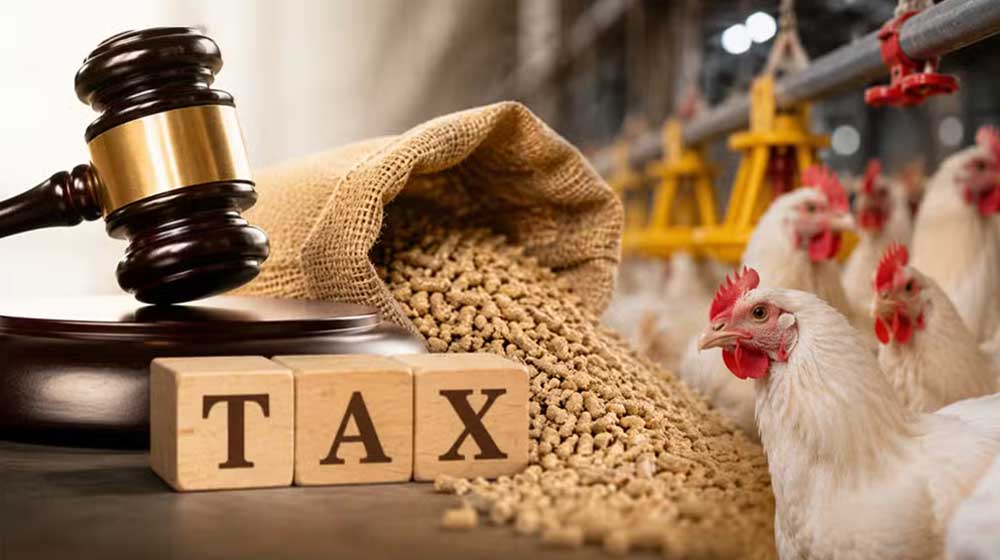
In a major setback for revenue collection, a federal court has declared poultry tax illegal weeks before the budget.
The Federal Constitutional Court delivered a decisive blow to the government’s tax strategy. A two-member bench headed by Justice Aamer Farooq overturned an earlier Lahore High Court ruling. Therefore, authorities cannot collect the 4 percent additional tax on poultry feed supplied to unregistered farms.
This poultry tax illegal ruling centers on Section 31A of the tax law. The government introduced the additional levy through the Finance Act 2024. However, the court observed that the provision contained significant ambiguity. Consequently, officials could not use it to impose the charge on feed manufacturers.
The judgment further clarified a crucial legal point. Poultry farms are exempt from taxation under the relevant legal framework. Therefore, they are not required to register for tax purposes at all. Additionally, the court noted that where the law grants such an exemption, neither the farms nor feed manufacturers can face penalties for lacking registration.
This poultry tax illegal declaration also provides complete legal protection to unregistered poultry farms. The law creates no mandatory registration requirement whatsoever. So imposing an extra tax on feed supplies to those farms was fundamentally wrong. Furthermore, poultry feed mill owners had challenged the levy by arguing exactly this point. Their farms enjoyed legal exemption, yet the government still demanded the additional payment.
Meanwhile, the timing of the ruling adds political pressure. The government faces a shrinking revenue base just before presenting the annual budget. Still, the court made its position unmistakably clear. Ambiguity in tax law cannot justify penalizing legally exempt entities.
Finally, the two-member bench held that the original levy had no valid legal foundation. Feed manufacturers can now supply unregistered poultry farms without fear of the 4 percent surcharge. Nevertheless, officials have not yet announced whether they will appeal the decision or rewrite the provision in the upcoming Finance Act.