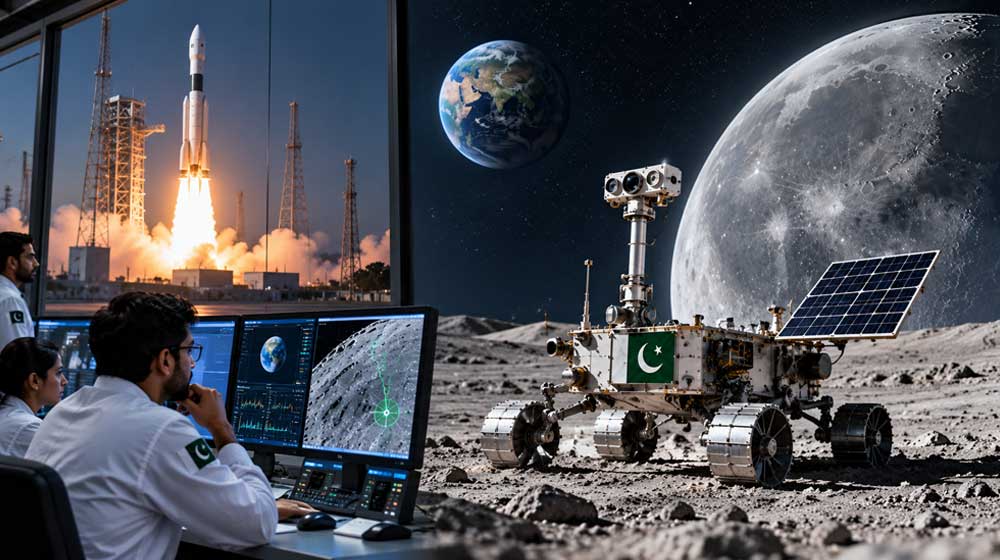
Jinnah-1, the country’s first Moon rover, is expected to land on the lunar surface in 2028. The Space and Upper Atmosphere Research Commission (SUPARCO) chairman, Yousuf Khan, shared the timeline at an event marking World Space Week. He used the occasion to review the progress of the national space program.
The Pakistan lunar rover forms part of a wider push to expand the country’s space and satellite capabilities. The mission would mark the first time Pakistan places a rover on the Moon. However, Khan did not share further details about the rover’s design or landing site.
Khan said the program has made significant progress in recent years. However, the strongest gains have come in the development and use of locally operated satellites. According to him, Pakistan is increasingly relying on its own satellites instead of European and Chinese systems. This marks a clear move toward greater self-reliance in space technology.
Pakistan launched its EO-1 satellite in January 2025. Two more satellites followed in July and October of the same year. Together, the three launches took place within a single year. The country currently has six Earth observation satellites in operation.
Furthermore, these satellites support several sectors, including agriculture, urban and development planning, and natural disaster management. Khan added that satellite technology is also helping expand internet access and television coverage across the country.
Additionally, he said continued investment in the space sector would further strengthen Pakistan’s technological capabilities. Such investment would also increase the use of satellite-based services in different areas. In practical terms, more people could benefit from satellite-based internet and television services.
Khan also highlighted the importance of public engagement. He said World Space Week plays an important role in introducing young people to space science and technology. Meanwhile, the Pakistan lunar rover remains a 2028 target. Overall, these developments show how quickly the country’s space program is expanding.