


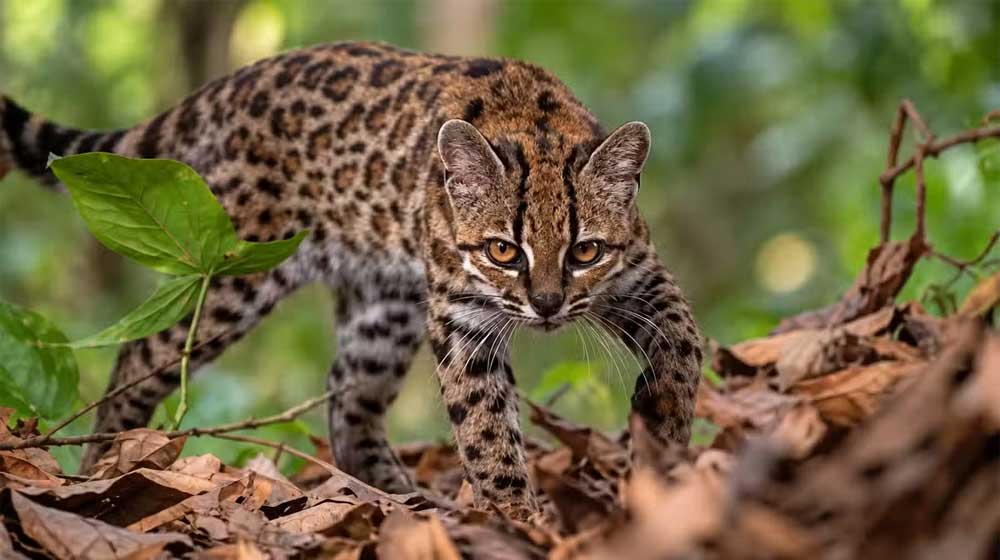
Scientists have identified a new wild cat species in Bolivia’s cloud forests. The discovery marks the first time researchers have formally named a living cat species in more than a century. Also known locally as Tilcayo, the animal belongs to a group of South American felines called tiger cats. Researchers also gave it the scientific name Leopardus tilcayo, keeping its traditional local name.
The cat lives in Bolivia’s Yungas forest, a mountainous region known for dense vegetation and frequent cloud cover. It measures around 18 inches long and weighs about three pounds, making it smaller than an average house cat. Genetic analysis therefore confirmed that Tilcayo represents a separate species.
Paola Nogales-Ascarrunz, a National Geographic Explorer, co-authored the study, which appeared in Current Biology. She described the cat as having light-brown fur with irregularly shaped rosettes across its body. Researchers still know very little about its behaviour.
New cat alert! A call from a wildlife sanctuary about a "weird cat" has led to the first new cat species discovered in over 100 years in Bolivia’s Yungas forest ecoregion. Learn more about this feline surprise: https://t.co/crffXvPqH4 pic.twitter.com/USo7rI3Y5q
— National Geographic (@NatGeo) September 17, 2026
However, scat samples containing small rodent remains suggest the cat preys on rodents. Camera-trap records also indicate that the cat is more active at night.
Tiger cats count as cryptic species, meaning different species look alike and are hard to tell apart by sight alone. Jonas Lescroart is an evolutionary biologist at the University of Antwerp and a co-lead author of the study. He explained that experts once treated tiger cats as a single species.
Still, decades-old genetic studies suggested the group actually held several separate species. Researchers currently have data from only two living Tilcayo individuals. One is a 10-year-old male now living at the Senda Verde Wildlife Sanctuary, after a local family previously kept him.
Scientists grew curious about the Bolivian cat because its features did not match existing descriptions. Those descriptions relied largely on tiger cats sampled from Brazil. The team therefore analysed DNA from 38 cats across several South American countries, including eight museum specimens.
Results showed that tiger cats actually form five genetically distinct species. Finding a new wild cat species of this kind is rare, researchers noted, and it surprised even Lescroart.
He said the team had not expected the Bolivian tiger cat to form its own species. Nobody had proposed it as a distinct animal before.
Genetic evidence suggests the Tilcayo lineage split from other tiger cats around 1.4 million years ago. That gap is generally considered enough to distinguish separate species among cats.
The researchers also described a new tiger cat subspecies from Peru’s Yungas. They named it Leopardus tigrinus antisuyo, after Antisuyu, a region of the former Inca Empire.
The IUCN Red List currently treats tiger cats as two vulnerable species with declining numbers. Researchers have shared their findings with the IUCN, which plans to assess the five lineages separately.
Lescroart said separate assessments could clarify the threats facing each group. Meanwhile, Tilcayo could qualify as endangered once evaluated on its own.
Finally, a clearer assessment could matter most in the Yungas, one of the region’s most threatened ecosystems. Additionally, the mountain forests face growing pressure from deforestation, agricultural expansion, fires and mining. Nogales-Ascarrunz said restoring fire-damaged forest and protecting native habitat should now rank as urgent priorities.
Eduardo Eizirik, senior author of the study, said the find shows how much biodiversity remains undocumented. That holds true even among familiar animals such as cats. He warned that many undiscovered species could disappear before scientists ever find them.

