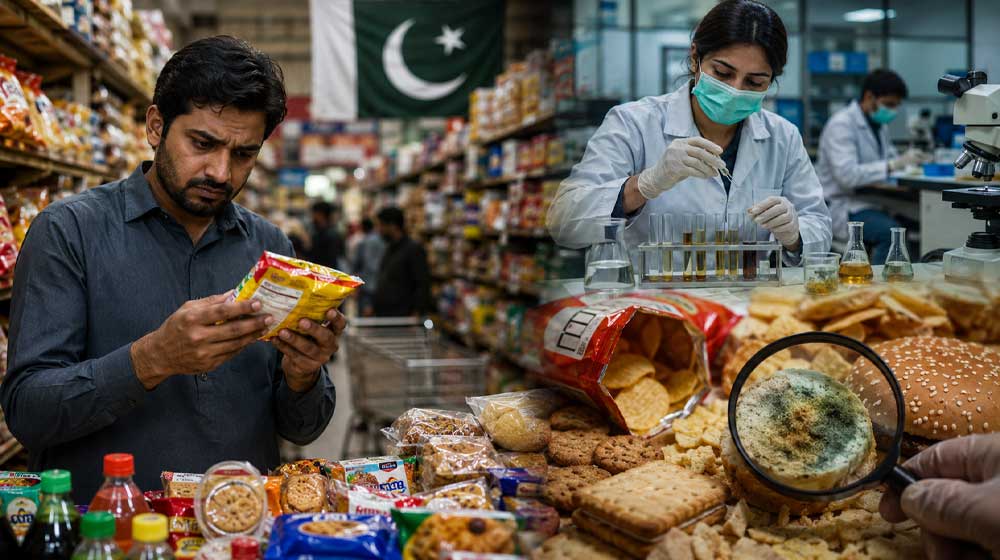
Pakistan faces a serious consumer crisis. Nearly 36 percent of packaged food quality failures plague the nation’s markets according to Ministry testing. Therefore, packaged food quality failures represent a genuine public health emergency requiring immediate government action. The Pakistan Council of Scientific and Industrial Research tested 491 samples from markets nationwide. Additionally, 176 samples failed to meet national standards while 315 complied fully.
Federal Minister Ahsan Iqbal presented findings during the National Price Monitoring Committee meeting. The assessment shocked officials with its scale and severity. Vanaspati ghee performed worst among tested products. Nearly 48 percent of ghee samples failed quality tests. Meanwhile, 40 out of 146 cooking oil samples proved substandard at 27 percent failure rate. Furthermore, 26 of 104 packaged milk samples also failed at 25 percent.
Additional testing revealed deeper concerns throughout. Eight of 18 milk powder samples did not meet standards. Three of four refined palm oil samples failed completely. One canola oil sample also proved substandard. Therefore, every dairy and oil product category showed significant compliance failures.
Specific deficiencies alarmed health officials particularly. One milk sample contained only 0.8 percent fat against the 3.5 percent minimum requirement. This dramatic shortfall means consumers receive substantially less nutritional value. Additionally, lesser-known local brands showed more failures than multinational producers. This pattern suggests manufacturing capacity and quality control gaps among smaller companies.
The findings raised serious concerns about food safety mechanisms. Existing regulatory frameworks clearly proved inadequate for protecting consumers. Additionally, enforcement mechanisms appear insufficient throughout supply chains. Meanwhile, vulnerable populations including children receive substandard nutrition unknowingly.
Iqbal connected food quality directly to rising health crises. Cardiovascular diseases and non-communicable illnesses increase among young Pakistanis. Poor nutrition contributes significantly to these trends. Furthermore, contaminated food products accelerate disease development substantially. Therefore, addressing food quality becomes a national priority urgently.
The minister directed provinces to conduct comprehensive surveys. Loose and unpackaged products require testing immediately. These unregulated sales channels pose even greater health risks than packaged goods. Additionally, regional trends need identification and analysis. The government must determine whether quality issues stem from production or storage problems.
Iqbal constituted a technical subcommittee immediately. Experts from Planning Ministry, PCSIR and PSQCA will examine findings thoroughly. They will submit evidence-based recommendations for regulatory action. Furthermore, next-phase testing will specifically target loose oils, ghee and milk. Finally, packaged food quality failures must decrease through comprehensive government intervention nationwide.