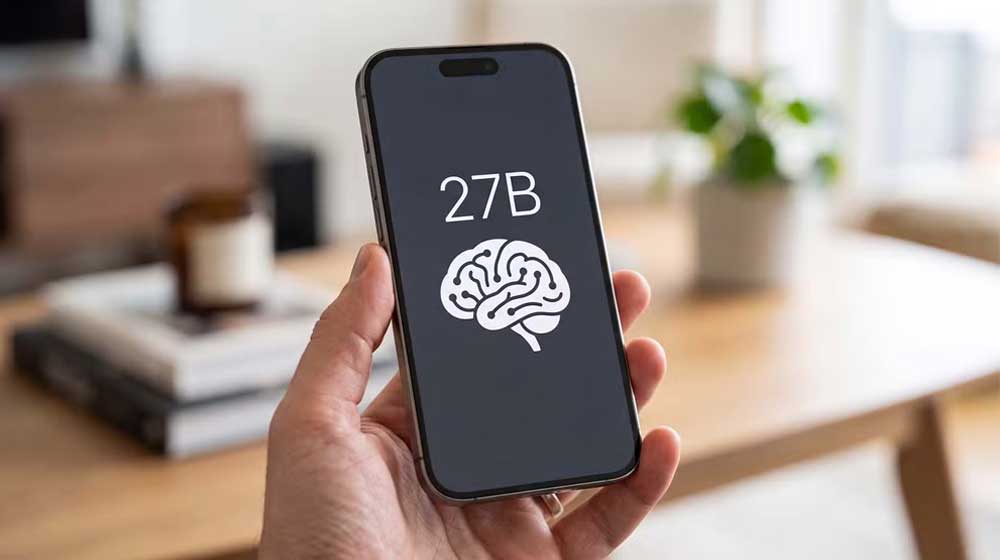
Apple’s iPhone 18 Pro has shown a major leap in on-device AI performance, running a massive 27-billion-parameter model at roughly twice the speed of the iPhone 17 Pro. This improvement comes largely from the new A20 Pro chip. The chip introduces a dual-16-core Neural Engine, and it pairs that with faster memory across both the iPhone 18 Pro and iPhone 18 Pro Max.
27B AI Model Runs Locally on iPhone
Developer Adrien Grondin demonstrated the Bonsai 27B model running directly on an iPhone 18 Pro. Notably, the demo showed significantly faster token generation than the previous-generation device achieved. Both new iPhone models carry 12GB of 96-bit LPDDR5X memory, a considerable upgrade over the iPhone 17 Pro series.
Additionally, the iPhone 18 Pro delivers 115.2GB/s of unified memory bandwidth. Combined with the A20 Pro’s dual-16-core Neural Engine, this gives the phone far more headroom for running AI models locally without an internet connection. The Neural Engine’s peak throughput can even exceed the A20 Pro’s 7-core GPU in workloads built specifically for the NPU.
The iPhone 18 Pro is much better than what I expected for on-device AI
— Adrien Grondin (@adrgrondin) September 19, 2026
It can run a 27B model at double the speed of the 17 Pro
The new A20 Pro chip is a beast pic.twitter.com/gb11TvBfn0
Memory Remains the Biggest Limitation
Despite this progress, the iPhone 18 Pro still hits real limits when handling larger AI models. The demonstration relies on the original Bonsai model, while the newer Bonsai 2 struggles to run locally using 2-bit quantization. Its memory demands simply exceed what the device comfortably offers, so squeezing the larger model into available memory degrades performance noticeably.
The original Bonsai model instead uses 1-bit quantization, making it far more memory-efficient. It can even run on devices with just 4GB of RAM, while phones carrying 8GB or 12GB have considerably more breathing room. Therefore, this efficiency lets Bonsai 27B take full advantage of the iPhone 18 Pro’s faster memory and Neural Engine without triggering the same memory pressure.
More RAM Could Unlock Larger Models
This demonstration highlights both real progress and lingering limitations for on-device AI on smartphones. The A20 Pro and its faster memory let the iPhone 18 Pro handle a dense 27B iPhone 18 Pro AI model configuration much faster than its predecessor managed. However, the phone’s 12GB memory ceiling still blocks larger or less aggressively quantized models from running efficiently.
Future iPhones with bigger memory configurations could therefore support denser on-device AI models that remain impractical today. Meanwhile, developers like Grondin continue pushing current hardware to its absolute limits. This trend suggests Apple’s AI ambitions for the iPhone are only just beginning to take shape.