

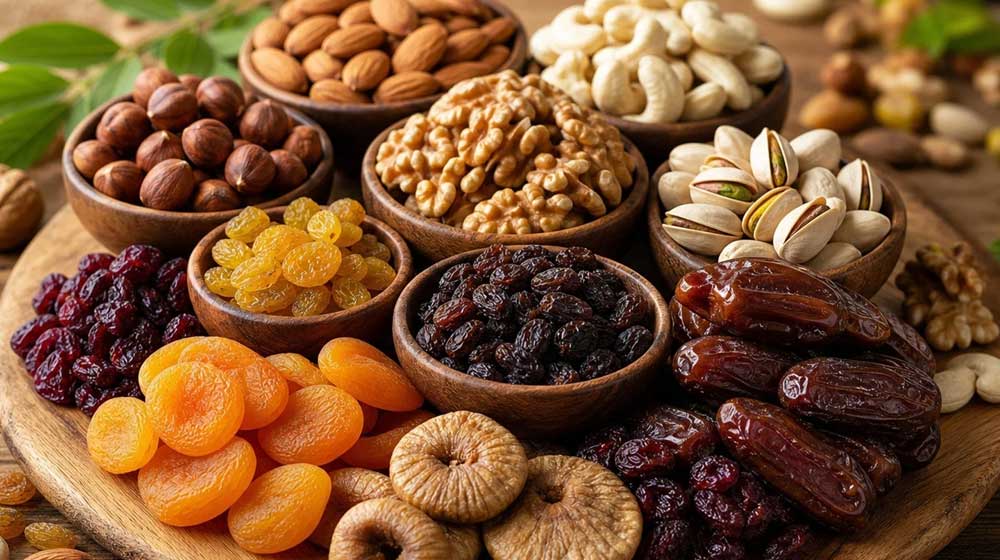
Pakistani households spend about Rs. 98 billion a year on dry fruits, according to Gallup Pakistan Digital Analytics. It based the estimate on the Household Integrated Economic Survey (HIES) 2024-25, a large government survey run by the Pakistan Bureau of Statistics. ProPakistani reported the analysis on November 16, 2026.
The survey visited 32,814 households between September 2024 and June 2025. So the numbers are not from this winter.
Premium nuts: Rs. 56 billion, few buyers
About Rs. 56 billion goes on almonds, walnuts, pistachios and cashews. Only 7 percent of households, around 2.7 million homes, bought them in a typical two-week period. Buyers spent about Rs. 800 on average.
The figures add up to the annual total. In our own check, 2.7 million households spending Rs. 800 in each of 26 two-week periods comes to about Rs. 56 billion.
Everyday dry fruits: Rs. 42 billion, more buyers
The other Rs. 42 billion goes on cheaper items such as dried dates, peanuts, coconut and sesame. About 12 percent of households, or 4.6 million homes, bought these in two weeks. They spent about Rs. 350. Peanuts and dates reach a wide range of income groups, according to the analysis.
Rich homes buy far more
Among the richest 20 percent of households, 15.5 percent bought premium nuts. Among the poorest 20 percent, only 3.6 percent did. That makes buying more than four times as likely in the richest homes.
Big gaps between provinces
Khyber Pakhtunkhwa had the highest premium nut buying rate at 14.4 percent of households. Punjab was at 5.9 percent and Sindh at 3.9 percent. In Islamabad, 38 percent of households bought everyday dry fruits.
Cashew imports jumped
Imports of shelled cashews rose from 329 tons in 2023 to 3,107 tons in 2024, almost all from Vietnam, according to trade data from Tridge. They were worth about $10.5 million. ProPakistani noted that imports are only part of the market. Pakistan grows much of its own almonds and walnuts, while most pistachios come from Iran and Afghanistan.