

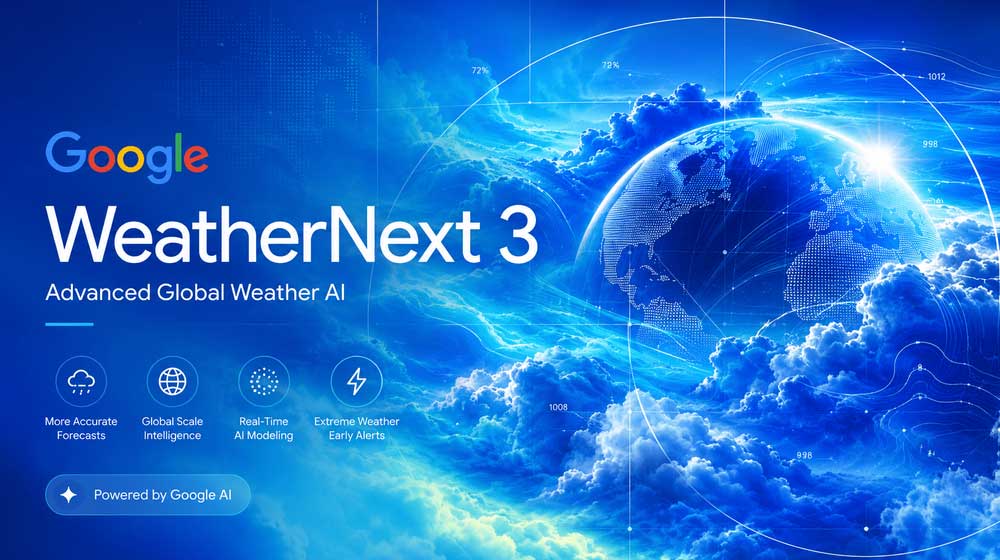
Google just revolutionized global weather forecasting significantly. Google DeepMind and Google Research introduced Google WeatherNext 3 as their most advanced model yet. Therefore, Google WeatherNext 3 represents substantial improvement over previous forecasting systems. Independent evaluations by Brightband confirm this model’s superior performance specifically. These live assessments rank it as the most accurate global weather model currently available.
This breakthrough stems from fundamentally different data approaches specifically. Unlike previous AI weather systems relying mainly on delayed numerical predictions, WeatherNext 3 learns directly from real-time observations. This includes both satellite and weather station data comprehensively. Additionally, the model produces new global forecasts every hour consistently. Furthermore, it provides predictions at resolutions as detailed as 5 kilometers specifically.
Higher-Resolution and More Frequent Forecasts
WeatherNext 3 generates hourly forecasts across multiple spatial resolutions simultaneously. Meanwhile, it maintains consistency between large-scale patterns and local conditions effectively. Key surface variables including temperature and moisture achieve 5km resolution specifically. Other surface variables utilize 10km resolution instead. Additionally, atmospheric variables like wind speed use 25km resolution.
Google states this delivers roughly five times sharper global weather pictures. This significantly improves upon WeatherNext 2’s 25km grid forecasts every six hours. The system employs a Functional Generative Network mesh transformer architecture specifically. This technology combines hourly geostationary satellite mosaics with traditional historical analysis. Consequently, it produces dense weather fields, cyclone tracks and location-specific forecasts.
Uses Live Satellite and Weather Station Data
WeatherNext 3’s most significant innovation involves its underlying data sources specifically. Most AI weather models, including WeatherNext 2, train on numerical weather prediction outputs. These physics-based systems require supercomputers and typically carry six-hour data delays. Google explains this delay creates problems forecasting rapidly changing conditions like rain and temperature.
WeatherNext 3 instead uses continuously updated global satellite observation mosaics. This enables hourly forecast generation using the latest available satellite data. Google says shorter update cycles provide earlier, more detailed information when storms develop quickly. Additionally, the model trains directly on sparse weather station observations specifically. Therefore, it better captures local geographic differences including coastlines, valleys and mountains. Google believes this proves particularly valuable across Latin America, Africa and Asia-Pacific regions. These areas historically faced limited high-resolution forecasting due to computing costs.
Major Improvement in Rain and Snow Forecasting
Precipitation forecasting has challenged both traditional and AI-based weather models historically. Therefore, Google specifically focused improvement efforts on this difficult area. WeatherNext 3 trains on NASA’s IMERG satellite data specifically. Additionally, it incorporates Google’s own precipitation reanalysis based on satellite radar information.
Google’s evaluations reveal impressive accuracy improvements substantially. The model achieved up to 60% improvement against IMERG in medium-range forecasts. Additionally, it improved up to 30% against MRMS measurements. Furthermore, early forecast lead times showed 10% improvement against rain gauge data. WeatherNext 3 also reproduces sharper precipitation system boundaries instead of blurred estimates from previous models.
Built for Renewable Energy Forecasting
WeatherNext 3 introduces specialized predictions designed for renewable energy production specifically. The model forecasts wind speeds at 100-meter heights, matching typical wind turbine elevations. Additionally, it provides high-resolution cloud cover and solar radiation forecasts. This helps solar farms estimate incoming sunlight accurately. Google states this information helps grid operators and developers estimate power generation. Consequently, this enables better matching between energy supply and consumer demand.
Where WeatherNext 3 Is Available
Google makes WeatherNext 3 data accessible without requiring model setup independently. Researchers, developers and businesses can access global forecasts through BigQuery and Earth Engine. Additionally, bulk data downloads remain available through Google Cloud Storage. Furthermore, WeatherNext 3 begins powering weather experiences across multiple Google products today. This includes Google Search, the Gemini app, Google Maps and related platforms.
Google emphasizes particular improvements for longer-term forecasting specifically. For forecasts made a day or more ahead, users could see precipitation predictions up to 50% more accurate. The largest improvements should appear in regions where forecasting historically proved less reliable. However, Google acknowledges that weather remains inherently unpredictable despite these advances. Therefore, the company advises relying on local meteorological agencies for official forecasts and severe weather warnings. Finally, Google WeatherNext 3 represents a significant technological leap forward while maintaining appropriate humility about weather’s fundamental unpredictability.