
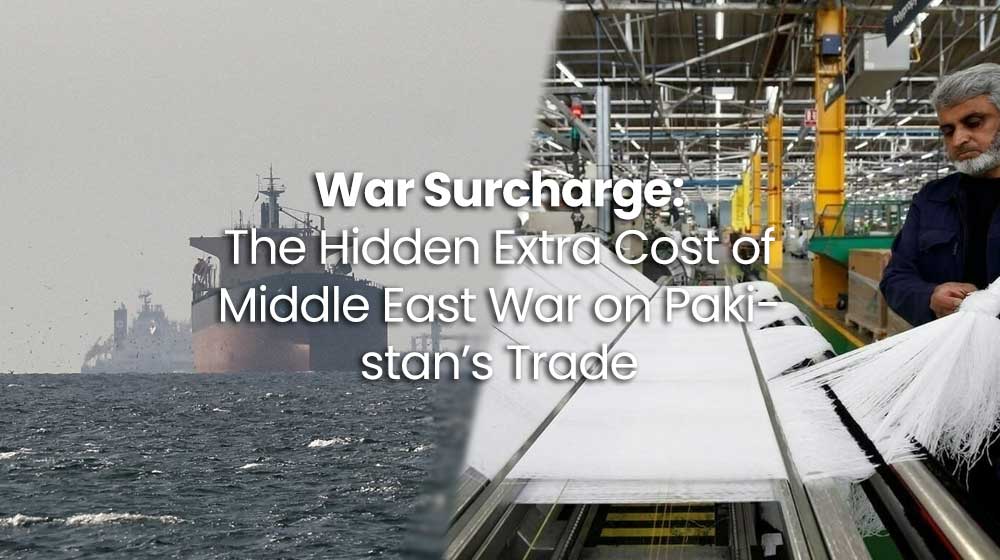
The fighting between the US, Iran, and Israel has made shipping routes dangerous. Shipping companies have started charging an extra “war surcharge” on every container coming to or leaving Pakistan. Textile expert Fawad Anwar says this hidden fee will hurt our economy badly if the government does not act fast. In this blog, we explain the problem in easy words and share the practical solutions he has suggested.
What is “War Surcharge”? Imagine you order something from abroad. Suddenly the shipping company adds an extra fee of $2,000 to $3,000 on each container just because there is war in the Middle East. This extra charge is called War Surcharge (or War Risk Surcharge).
Big shipping lines like MSC, Maersk, and CMA CGM have started adding this fee because ships now face danger near the Strait of Hormuz and Bab el-Mandeb. They say it is risky, so they want more money.
Why Should Pakistan Worry? Pakistan buys and sells a lot through sea routes. Almost everything — from raw cotton and chemicals to finished clothes — travels by ship.
If the war continues:
- Importers will pay more
- Exporters will earn less
- Prices of daily items may go up
- Our factories (especially textile factories) will struggle
Experts say this one extra fee could add more than $1 billion to Pakistan’s total trade bill every year. That is a huge amount for our country.
Who is Most Affected? The textile industry is hit the hardest. Pakistan is one of the biggest textile exporters in the world. We import raw materials and send out finished garments. Every extra dollar in shipping cost makes our products more expensive than those from India, Bangladesh, or Vietnam.
What Does Fawad Anwar Suggest? Fawad Anwar, Chairman of the Pakistan Textile Council, recently explained everything in a clear video. He also wrote official letters to the government. Here are the simple and practical steps he wants the government to take right now:
- Government-backed Insurance The government should give a guarantee to local insurance companies (like NICL and Pakistan Reinsurance). This way, Pakistani companies can buy cheaper insurance instead of paying huge international fees. Shipping lines will then lower or remove the surcharge for Pakistan.
- Talk Directly to Shipping Companies The Ministry of Commerce and Ministry of Maritime Affairs should sit with big shipping lines and say: “If we give you insurance guarantee, please cap or reduce the surcharge for Pakistan only.”
- Temporary Help for Exporters Start a short-term loan scheme (like the TERF scheme used during COVID) so exporters can easily borrow money to pay the extra shipping costs for a few months.
- Other Quick Actions
- Ask the Competition Commission to check if shipping companies are charging unfair extra fees.
- Use Pakistan National Shipping Corporation (PNSC) ships to carry more of our cargo.
- Fix delays at ports so companies don’t pay extra demurrage charges.
Why Act Fast? If the government takes these steps quickly, Pakistan can avoid the full burden of the war surcharge. Other countries are already doing similar things. We should not wait until prices rise and factories start closing.
Final Thought War in the Middle East is far away, but its cost is reaching our ports and factories today. A “war surcharge” sounds technical, but it simply means higher prices for everyone in Pakistan. Fawad Anwar has given clear, practical solutions. Now it is up to the government to act fast and protect our trade and jobs.
What do you think? Should the government start the insurance guarantee scheme immediately? Share your thoughts in the comments.
(Based on the official explanation by Pakistan Textile Council Chairman Fawad Anwar and recent letters sent to the government in 2026.)