

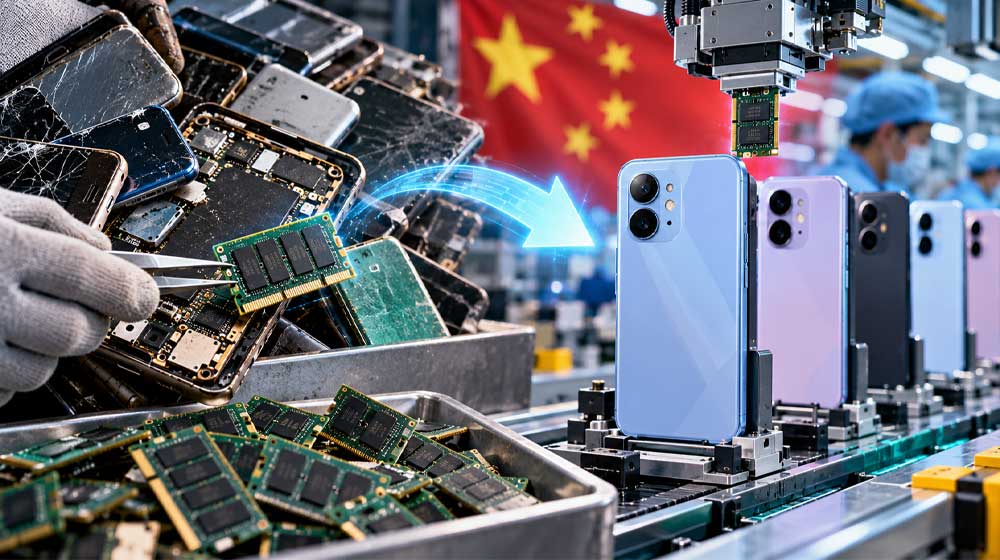
Some Chinese smartphone makers have started putting recycled RAM chips, taken from old phones, computers and servers, into new smartphones, as a worldwide memory shortage drives up prices. Market research firm Counterpoint Research described the trend to South Korea’s Chosun Biz on October 20, 2026.
RAM is a phone’s short-term working memory. It is what lets you keep several apps open and switch between them quickly. The type used in phones is called DRAM.
According to Counterpoint, Chinese phone makers sharply cut their targets after the second quarter of 2026, reducing staff and spending as memory prices climbed. From the end of the third quarter, some started raising production targets again, and Counterpoint linked that change to wider use of recycled memory.
Some companies are even considering using only recycled RAM in their cheapest phones, Chosun Biz reported. No brand or phone model has been named so far.
Chips pulled from scrap phones and servers
The process is simple. Workers remove the memory chips soldered onto old circuit boards, clean them, run basic tests and solder them onto new boards.
A trade in such chips already exists at Huaqiangbei, a huge electronics market in Shenzhen, China. Sellers there take memory out of scrapped phones, clean and reprocess it, and sell it on.
The supply is growing beyond old phones. Counterpoint said older DDR4 memory thrown out by big US data centre companies could also end up in this recycled market.
A Counterpoint official told Chosun Biz the trend shows how bad the shortage has become. In their words, phone makers are turning to used chips because they cannot get enough new ones through normal channels.
Used chips wear out faster
The risk for buyers is how long these phones will last. Counterpoint said that in some markets, chips that have already been used for five to six years are being reused for another five to six years.
Memory wears out with age. The longer a chip is used, the worse it gets at holding data, and the higher the chance of errors. That can show up as random app crashes, freezing or restarts.
Basic testing can catch chips that are already dead. It cannot show how much life a working chip has left.
For buyers, a few habits now matter more with budget phones. Buy from an official seller and keep the receipt. Make sure the warranty is registered. If a new phone starts freezing or restarting for no clear reason, take it back while it is still under warranty.
Cheap phones hit hardest by the shortage
The shortage started with artificial intelligence. Memory makers such as Samsung Electronics and SK Hynix are putting their factories to work on more profitable chips for AI servers, including high-bandwidth memory (HBM). That leaves less supply of the low-power memory that phones use.
The effect on prices is already large. Counterpoint said global smartphone shipments fell 20% in July to September 2026 compared with a year earlier, the lowest third-quarter figure since 2012. It said phone prices worldwide have risen about 20% so far in 2026.
Budget phones are taking the biggest hit. In a June 2026 report, Counterpoint said phones priced at $99 or less were losing market share faster than the overall market was shrinking. It named Transsion, the company behind Infinix, Tecno and itel, along with Xiaomi, as among the most exposed brands.
Counterpoint expects the memory shortage to start easing only from the end of 2027. Until then, cheaper phones may keep getting pricier, harder to find, or built with second-hand parts.