
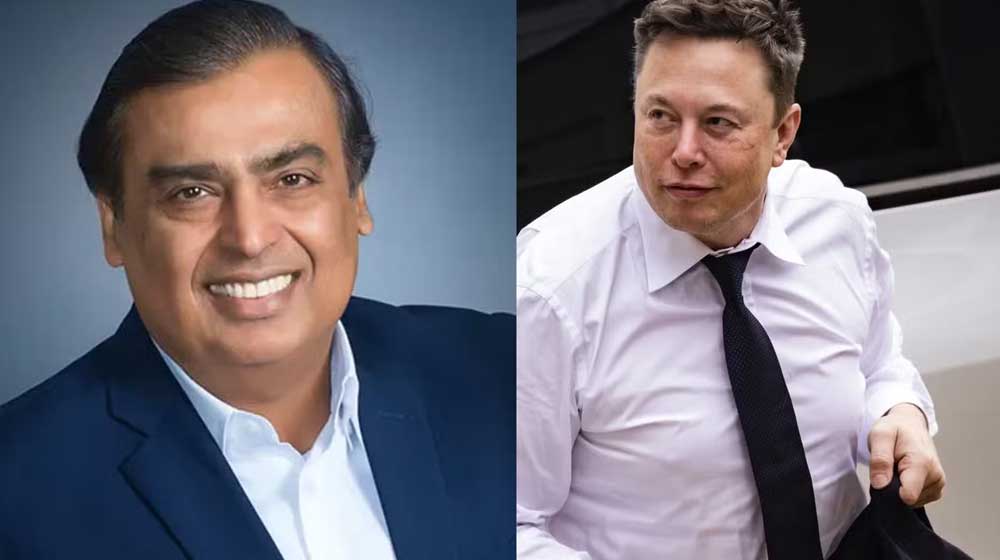
Elon Musk has publicly challenged Indian billionaire Mukesh Ambani over the continued delays affecting Starlink’s entry into India’s internet market.
The Tesla and SpaceX chief executive made a sarcastic appeal to Ambani through a post on X on Friday.
Dear Prime Minister Ambani, Please accept my humble apologies for not realizing that you are the real boss of India. Naturally, you would prefer to maintain your monopolistic exploitation of the great people of India, but would you nonetheless consider allowing Starlink to compete? There are many areas of India, as there are in all countries, with no Internet access, which denies children the opportunity for education and for small businesses the opportunity to sell their goods to a global market. Starlink would change their lives for the better. Thank you 🙏
— Elon Musk (@elonmusk) October 9, 2026
Musk described Ambani as the “real boss of India” while questioning the obstacles preventing Starlink from launching commercial services.
Moreover, he suggested that powerful business interests were influencing competition in India’s rapidly expanding telecommunications sector.
In his post, Musk sarcastically apologized to Ambani for failing to recognize his supposed influence over the country’s internet industry.
“Please accept my humble apologies for not realizing that you are the real boss of India,” Musk wrote.
He then questioned whether Ambani would allow Starlink to compete against established telecommunications companies.
Additionally, Musk accused the billionaire of wanting to maintain monopolistic control over India’s internet market.
His comments have intensified attention on the Starlink India Launch and the regulatory challenges surrounding its commercial operations.
Ambani controls Reliance Industries, which owns Jio, one of India’s largest telecommunications operators.
Jio has established a significant presence in the country’s mobile and broadband markets. Meanwhile, Starlink aims to introduce satellite-based internet services that could reach underserved communities.
Musk argued that greater competition would benefit millions of Indian citizens who currently lack reliable internet connectivity.
According to him, satellite internet could create new educational opportunities for children living in remote areas.
Furthermore, improved connectivity could help small businesses reach international customers and expand their commercial activities.
Musk also highlighted Starlink’s role in providing emergency communications during natural disasters.
He claimed that the satellite network has helped save lives when traditional communications infrastructure failed.
Additionally, Musk suggested that expanding Starlink services across India could improve emergency response capabilities during major disasters.
The billionaire’s latest remarks follow earlier criticism of regulatory obstacles delaying the company’s commercial launch.
Previously, Musk questioned whether Ambani’s business influence played a role in the lengthy approval process.
However, the Indian government has rejected allegations that influential telecommunications companies are blocking Starlink to protect existing operators.
Authorities have denied Musk’s suggestions that commercial interests are responsible for the delays.
Meanwhile, the disagreement highlights growing tensions between satellite internet providers and established telecommunications businesses.
Starlink operates through a network of satellites designed to deliver broadband connectivity without relying entirely on traditional ground infrastructure.
This technology could prove particularly useful in rural and geographically isolated regions.
However, satellite internet operators must navigate regulatory requirements before offering commercial services in new markets.
For Starlink, gaining access to India’s enormous telecommunications market remains an important business objective.
The country represents a significant opportunity because of its large population and increasing demand for reliable digital connectivity.
Nevertheless, Musk’s public criticism has brought additional attention to the relationship between regulatory decisions and market competition.
The Indian government continues to reject claims that established business interests are preventing Starlink’s entry.
For now, the company faces uncertainty over its commercial launch timeline. Meanwhile, Musk’s latest remarks have placed Mukesh Ambani at the center of the ongoing debate over India’s internet market.