The government will not fully disclose civil servants’ assets, citing security concerns. Instead, the government will publish selected information by December to satisfy conditions set by the International Monetary Fund. Finance Secretary Imdadullah Bosal shared the plan with the National Assembly Standing Committee on Finance and Revenue.
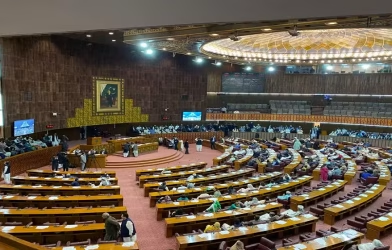
Parliamentarians quickly questioned the decision. They asked why civil servants should be treated differently from politicians, who must fully declare their assets, including the president and prime minister. Bosal did not directly address the objection. However, he noted that the Establishment Division and Federal Board of Revenue had completed extensive technical work on the new mechanism.
Under the new system, the FBR will assess declarations and report its findings to the Establishment Division. The division will then have the authority to initiate disciplinary action if discrepancies emerge. Civil servants will declare their assets under prescribed guidelines, though authorities will not publish the declarations in full.
The government has already begun digitizing income and asset declarations for all federal civil servants in BS-17 and above. This move replaces the old manual submission process with a dedicated FBR online portal. Additionally, the FBR will conduct risk-based verification and will make selected non-sensitive information public.
The Finance Ministry has also published an office memorandum from the Establishment Division on digitizing civil servants’ assets under Section 15-A of the Civil Servants Act, 1973. Furthermore, the Establishment Division, working with the FBR, has launched a digital system for submitting, verifying and publishing these declarations.
All officers in BS-17 and above must submit their declarations for financial year 2025-26 through the FBR portal instead of the manual process. The deadline for digital filing is October 30, 2026, according to Rule 12(6) of the Civil Servants (Conduct) Rules, 2026.
To create an account, officers must provide their name, designation, personal email, mobile number and CNIC to their cadre administrator. Therefore, the administrator forwards these details to the FBR, which notifies officers about account creation via email, SMS or other means. Officers will activate their accounts using their CNIC and a one-time password before setting their own passwords.
Once logged in, they will select a “Declaration” option and fill in the required information across several screens. The FBR will carry out risk-based verification on the submitted information and communicate results to the relevant cadre administrator. Meanwhile, the Establishment Division confirmed that it would publish selected non-sensitive sections of the declarations on the FBR website.
Officers may also correct errors on the portal until November 30, 2026, subject to approval from their cadre administrator. Still, questions remain about whether partial disclosure will satisfy lawmakers pushing for full transparency.