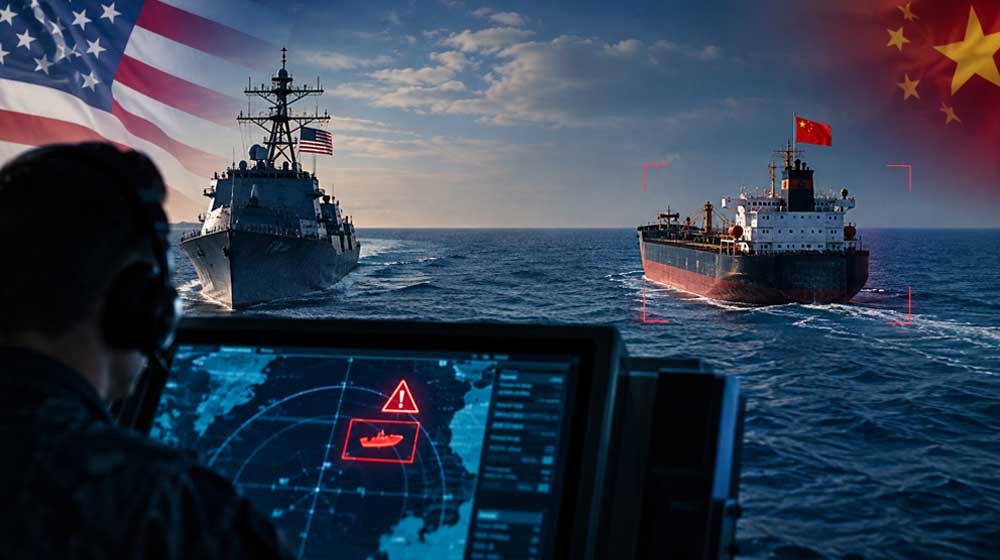
The US military came dangerously close to launching an armed operation against a Chinese vessel this spring, according to CNN. Officials only halted the mission after discovering that the intelligence behind it was flawed. Military aircraft were already in the air when the error came to light. Armed personnel had also been preparing to board the vessel before the operation was called off.
AI Misidentified the Ship’s Cargo
The flawed intelligence circulated inside the US military during the recent conflict with Iran. It claimed that a Chinese vessel in the Middle East was transporting components linked to a nuclear weapons program. According to the report, a Special Operations Command analyst had used an AI chatbot to merge open-source information with classified signals intelligence. The chatbot then misidentified key details about the ship’s cargo manifest.
The analyst used the AI tool again to transform the findings into an official-looking intelligence summary. That summary subsequently moved through military command channels without independent verification. Experienced analysts later reviewed the underlying material and discovered the AI chatbot error before the mission proceeded further. The operation was stopped just in time.
Concerns Over AI in Military Decision-Making
Additionally, this incident comes as the US military continues integrating artificial intelligence into intelligence analysis and other operations. The Pentagon has promoted AI as a tool to accelerate military decision-making, including shortening the gap between identifying a target and responding to it. However, this episode shows how inaccurate AI-generated information can also move quickly through decision-making systems when nobody checks it independently.
Jake Steckler, a GovAI research scholar and former US Army officer, told TechCrunch that military personnel need to understand the uncertainty built into large language models. This matters especially when AI plays a role in intelligence, targeting, or operational planning. Still, Steckler argued that the incident should lead to stronger safeguards rather than abandoning the technology altogether. He said AI tools can remain useful in appropriate situations.
Meanwhile, he warned that prioritizing rapid deployment without sufficient safeguards could undermine service members’ trust in these systems. Finally, the episode highlights how AI hallucinations can move beyond incorrect chatbot answers and into decisions carrying real military and geopolitical consequences. This AI chatbot error therefore serves as a stark warning about unchecked automation in high-stakes military decisions.